
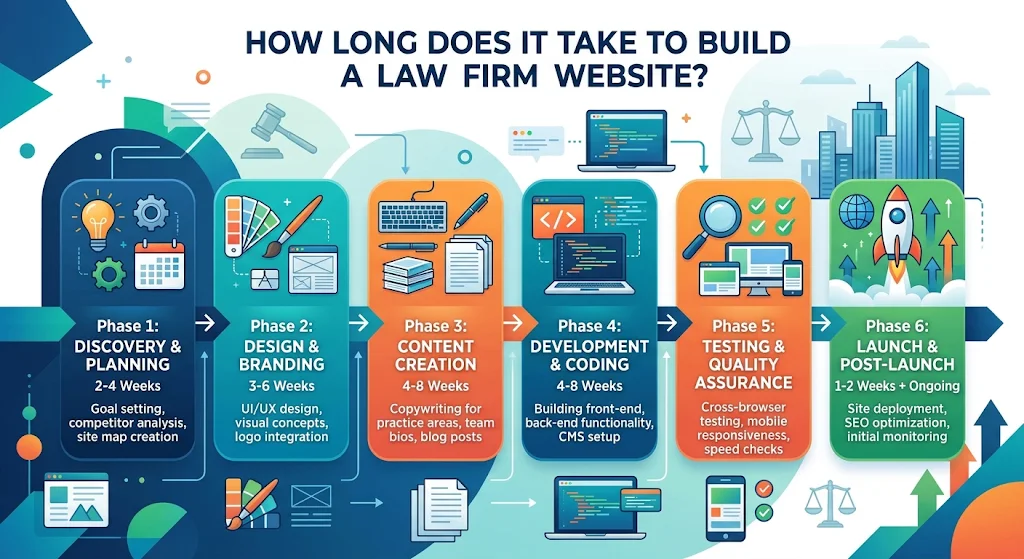
How long does it take to build a law firm website? Most projects take about 4 to 12 weeks from kickoff to launch. Simple template sites sit at the short end, and builds for firms with several practice areas and locations sit at the long end. The surprise is that design is rarely the slowest part. Content, approvals, and compliance review usually decide the launch date.
Most guides on this topic list the phases of a project and stop there. This guide explains the Three Clocks that actually control your schedule, gives you a sample ten week plan showing who owns each week, and lists the decisions you can settle before kickoff to avoid weeks of delay.
How Long Does It Take to Build a Law Firm Website? Typical Ranges
These are rough ranges. They assume prompt feedback and content that arrives on time.
- Solo attorney or small firm on a template: about 3 to 6 weeks.
- Small firm with a custom design: about 8 to 12 weeks.
- Firm with several practice areas or locations: about 12 to 20 weeks.
- Redesign of an existing site with many pages: add about 2 to 4 weeks for planning, redirects, and testing.
If a vendor promises something dramatically faster, ask what is being skipped. If a project runs far longer than these ranges, one of the three clocks below has usually stopped.
The Three Clocks That Decide Your Launch Date
- The vendor clock. Design, development, and testing. This clock is fairly predictable, and a good vendor can tell you how long each step takes.
- The content clock. Attorney bios, photographs, practice area pages, and answers to common questions. The firm owns this clock, and it is the most common cause of delay. Busy attorneys do not find time to write unless the work is scheduled.
- The approval clock. Every round of feedback, from every partner, plus any ethics or compliance review. This clock slows down with each extra person who has to approve something.
When a project slips, ask which clock stopped. The answer is usually the second or the third, and it can be fixed with planning rather than pressure.
A Ten Week Sample Plan
Here is a typical schedule for a small firm with a custom design. Adjust the weeks to your scope.
- Week 1, kickoff and decisions. The firm names one decision maker, shares domain and hosting access, and confirms goals, practice areas, and audience. The vendor confirms scope and schedule.
- Week 2, structure and content plan. The vendor proposes the page list and navigation. The firm assigns who writes or reviews each page, schedules attorney interviews, and books the photo session.
- Weeks 3 and 4, design concepts. The vendor presents the homepage and one interior page. The firm returns one consolidated round of feedback.
- Weeks 4 to 6, content in parallel. Drafts are written from interviews and reviewed by the attorneys. A compliance review lane runs alongside, not at the end.
- Weeks 5 to 7, build. The vendor builds templates, forms, tracking, and the redirect plan for any old pages.
- Week 8, loading and testing. Content goes in. Forms, phone links, accessibility, and speed are tested on real devices.
- Week 9, review and fixes. The firm completes one final review round, ethics review is finished, and staff learn how to make simple edits.
- Week 10, launch. Final checks, launch, and close monitoring in the first days.
Decisions to Settle Before Kickoff
Every unsettled item adds days. Gather these before the project begins.
- The single person who has final say on design and content.
- Logins for the domain registrar and any current hosting.
- Logo, colors, fonts, and any brand guidelines.
- Professional photos of attorneys and the office, or a date for a photo session.
- Attorney bios, bar admissions, and credentials.
- The list of practice areas and locations, and which must exist at launch.
- How inquiries will be handled, who answers them, and how fast.
- Which phone numbers will be used, and whether call tracking is planned.
- The person who will handle ethics or compliance review.
Seven Habits That Keep a Project on Schedule
- One decision maker and one consolidated feedback round per milestone. Scattered comments from five partners are the fastest way to lose a week.
- A 48 hour review rule. Agree at the start that each review request gets an answer within two business days.
- Start content on day one. Interviews are easier than a blank page, and they run on your calendar while design proceeds.
- Book the photo session early. Schedules and weather cause more delays than anyone expects.
- Run compliance review in parallel. Do not leave ethics review for the last week.
- Freeze the scope. Capture new ideas in a phase two list instead of adding them midstream.
- Plan a phased launch. Launch the core pages first, then add remaining practice areas over the following weeks.
Teams that specialize in legal website design usually build these habits into their schedule, so ask any vendor to show you theirs before you sign.
What Can and Cannot Be Rushed
Some steps flex, and some do not.
- Can be rushed: choosing a template or direction, the number of concept rounds, and writing content in parallel with design.
- Cannot be rushed safely: ethics and compliance review, testing, accuracy checks on legal content, and redirect planning for old pages.
Skipping testing is how phone numbers end up wrong on launch day. A slightly later launch is better than a fast one with errors.
Warning Signs of a Slipping Schedule
- No content has arrived by week four.
- More than two people are giving conflicting feedback.
- New pages keep being added after design approval.
- Either side goes a week without responding.
When you see these signs, reset the scope, cut the launch pages to the essentials, and move the rest to phase two.
Q&A: Common Questions About Building a Law Firm Website
How long does it take to build a law firm website?
Most take about 4 to 12 weeks from kickoff to launch. Small template sites can be done in 3 to 6 weeks, and larger firms with several practice areas or locations often need 12 to 20 weeks.
Why do law firm websites take longer than other small business sites?
They usually need detailed attorney bios, careful wording about services and results, multiple reviewers, and compliance checks under state advertising rules. Each adds time.
Can a law firm website be built in two weeks?
Sometimes, for a very small site on a template when every piece of content and every decision is ready on day one. Plan for more time if anything is still unwritten.
What slows a website project the most?
Late content and slow or conflicting approvals. Design and development are usually the most predictable parts of the schedule.
How long does a website redesign take?
About as long as a new build, plus extra time to map old addresses to new ones, test redirects, and move existing content.
Should we launch every practice area at once?
Not necessarily. A phased launch gets a strong core site live sooner. Add remaining practice areas in the weeks after launch as their content is approved.
When should I start writing content?
On day one, or even before you hire a vendor. Scheduling attorney interviews early keeps the content clock running while design is underway.
What should I give my web designer at the start?
Your decision maker, domain and hosting access, brand assets, photos, bios, the list of practice areas and locations, and the name of whoever will handle compliance review.
The Bottom Line
Building a law firm website takes weeks, not days, and the calendar depends more on your content and approvals than on the vendor’s design skills. Name one decision maker, start the content early, run compliance review in parallel, and plan a phased launch. Do that, and the three clocks tend to run together.